
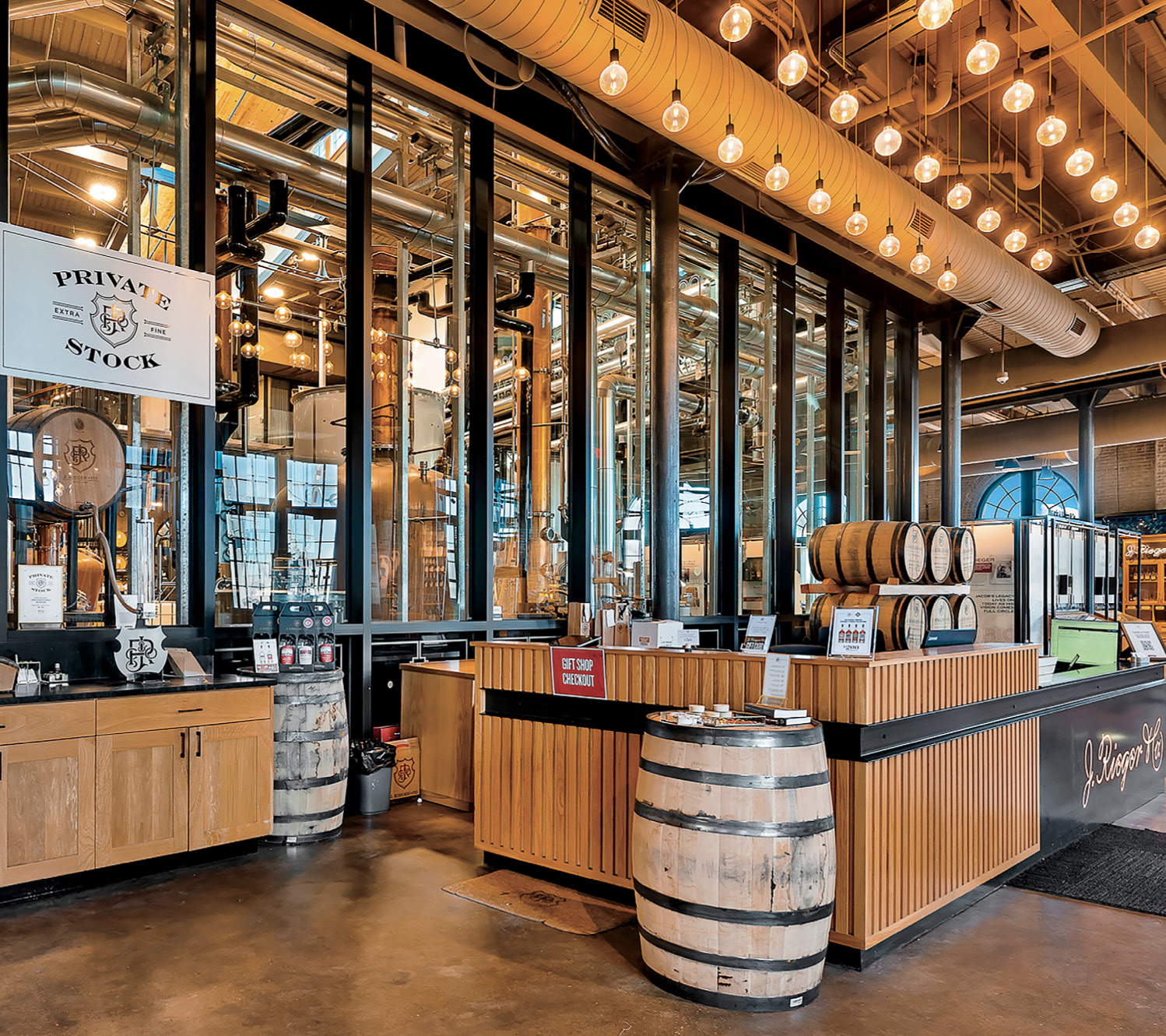


ON JANUARY 16, 1919, THE U.S. CONSTITUTION was amended to ban the sale of alcohol. It’s been just over 90 years since Prohibition ended in 1933, a social and political experiment that set back American-made spirits for generations. Only six distilleries were allowed to legally stay open during Prohibition, and it has taken decades for the independent craft sector to recover. The United States now boasts around 2,000 active distilleries; most were founded within the past 30 years, part of a remarkable but fragile resurgence. It’s a competitive industry where fortune favors the bold. For one rising Kansas City distillery, that edge came from an unexpected source: Jerez, the historic fortified wine of Southern Spain, now in the midst of its own revival.
J. Rieger & Co. sits beside the train tracks in Kansas City’s Electric Park District, where the soft, rhythmic rumble of passing freight settles into the whiskey as it ages. The premier distillery and cocktail destination occupies a beautiful landmark building in the former bottling plant of the Heim Brewing Co., a once-prosperous brewery. Prohibition wiped out countless distilleries, wineries and breweries—along with generations of hard-earned knowledge. In its heyday, Kansas City was also home to Jacob Rieger & Company, one of the nation’s largest mail-order spirits houses, founded in 1887, another casualty of the dry amendment. The distillery was largely forgotten until 2009, when award-winning bartender and bar owner Ryan Maybee opened Manifesto, a groundbreaking speakeasy with a secret entrance in the basement of the historic Rieger Hotel. Built by the enterprising Rieger family in 1915 to serve business travelers passing through nearby Union Station, the building still bore a ghost of its spirited past: a faded mural advertising the distillery’s flagship Monogram Whiskey. In 2010, as Maybee prepared to open a restaurant in the hotel, he had developed a full-blown obsession with the “old distillery.” On opening night, history caught up with the times—the last living descendant of the Rieger family walked in and introduced himself.
“Ryan thought I was trying to get something for free,” Andy Rieger, the great-great-great grandson of Jacob Rieger, says with a laugh. “I went in because my dad, before he passed away, asked me to go. I was having a drink at the bar and Ryan walked up and said we should partner someday and do the distillery again.” In 2014, Rieger and Maybee relaunched J. Rieger & Co., the first distillery to open in Kansas City since Prohibition.
Starting a distillery is a formidable undertaking—highly capital-intensive and subject to complex regulatory frameworks, the industry has faced many recent headwinds, from COVID to tariffs. On the plus side, post-Prohibition entrepreneurs have enjoyed a fresh break from the past that appeals to their creative instincts. Today’s leading distillers—much like aspiring chefs—do their best work off-script, free to redefine ingredients and techniques.
The independent spirits movement is far younger than many realize. In 1982, St. George Spirits was founded in Emeryville, California, by Jörg Rupf, a German immigrant and former judge. Drawing inspiration from his family’s tradition of distilling fruit brandies in Germany’s Black Forest, Rupf set out to apply old-world distillation savoir faire to a supply of orchard-grown fruit. At a time when only 20 distilleries operated in the United States, Rupf was manning a single 65-gallon Holstein pot still to craft eaux-de-vie from pears, raspberries and cherries—bootstrapping techniques that would best the finest fruit brandies of Europe within a decade. St. George became known for its boundary-pushing approach: treating spirits with the same reverence for raw materials, terroir and technique as fine wine. Operating out of a converted airplane hangar in Alameda, California, St. George created (and later sold) Hangar 1 Vodka and expanded well beyond brandies into groundbreaking gins, absinthe and whiskeys. Along the way, Rupf and his team have trained and inspired countless distillers chasing their own dreams.
In 2013, Rieger and Maybee were contemplating their first whiskey formulation. “We knew we wanted our whiskey to be cocktail-friendly, priced right and with a strong connection to home,” Maybee recalls. They started out with a blend of whiskeys varying in age from 5 to 11 years. “It was close—but something was missing,” Maybee recalls. The breakthrough came courtesy of the late, great Dave Pickerell while sampling the new whiskey trials at the Carousel Bar in New Orleans’ French Quarter—a circus-like setting to solve a thorny problem.
A legendary distillery consultant, Pickerell, who died in 2018, was a guiding light to dozens of start-up distilleries looking to navigate the vagaries of liquor law and find their own way. As Maybee lamented, Pickerell researched. He found a little-known footnote in the depths of the official TTB (The Alcohol and Tobacco Tax and Trade Bureau) regulations. “Through established trade practice,” the paragraph proclaimed, whiskey producers were allowed to add up to 2.5% Sherry to their products. Maybee had competed in the 2007 Vinos de Jerez Cocktail Competition in Spain, led by Sherry expert Steve Olson, and had a deep affinity for the category. He had landed on the missing ingredient and set off to Jerez.
On a tasting tour of multiple bodegas in the Sherry region, Maybee visited Williams & Humbert, a prestigious house dating back to 1877, and chose Dry Sack Williams & Humbert 15-Year Solera Especial Oloroso to round out Rieger Kansas City Whiskey. It proved to be an artful touch—adding a subtle edge that lifted the whiskey at its core while reviving a once-routine American practice. In the 18th and 19th centuries, Sherry was among the most widely consumed wines in the United States and was frequently blended into whiskey and shipped in large casks that later found second lives in American distilleries. Maybee became convinced that the historic Rieger distillery had followed the long-standing trade practice of adding a small measure of Sherry to its whiskey. When federal regulators initially moved to classify the modern formulation as a down-market “distilled specialty spirit”—arguing that the presence of Sherry was not permitted in American whiskey—Maybee pushed back. He cited the federal statutes that predated Prohibition and explicitly allowed for the addition of up to 2.5% Sherry. The result was a rare regulatory reversal by the TTB, which allowed Rieger to adopt a new moniker on its label: Kansas City Whiskey.
Launched in 2014, Rieger Kansas City Whiskey blends straight bourbon, straight rye and light corn whiskey—each aged a minimum of four years—with a dash of 15-year-old Williams & Humbert Solera Especial Oloroso. Balanced and smooth, it’s a whiskey that shines neat or in cocktails and has emerged as a signature style.
As an accomplished bartender, Maybee is not alone in his fondness for Sherry. Elite bartenders are particularly drawn to the range of flavor profiles within this classic fortified wine category and have driven its recent revival. Drinks like The Sherry Cobbler, a mix of Sherry, fruit and fresh herbs served over ice, were the height of fashion in the late 19th century. Cocktailing has become the gateway to a modern-day audience after a long slump in sales; prized for its versatility behind the bar, Sherry layers in savory or sweet notes, adds complexity at lower alcohol levels, and rounds out flavors like amari, citrus and oak-driven spirits. It’s a category with many superpowers—a chameleon that stirs true passion with wine and spirits insiders—yet one that remains largely misunderstood by the broader public.
In as simple terms as possible: Sherry is a fortified wine from Andalucia, produced exclusively in the Sherry Triangle—anchored by the towns of Jerez de la Frontera, Sanlúcar de Barrameda and El Puerto de Santa María. Made primarily from the Palomino grape, Sherry is strengthened (or fortified) with grape spirit after fermentation, a step that defines its style and aging path. Some Sherries age under a natural layer of yeast called flor, yielding pale, bone-dry styles like Fino and Manzanilla; others age with exposure to oxygen, producing richer, amber-hued wines such as Amontillado, Oloroso and Palo Cortado. Many are aged using the very distinctive solera system—a centuries-old fractional blending method where small portions of mature wine are drawn from the oldest casks for bottling, then replaced with younger wines to layer in freshness and character. To paint a picture, a solera resembles a living library of barrels, with pitch-black 500-liter botas (or casks) stacked in rows from oldest to youngest, quietly slumbering in the cathedral-like bodegas of Jerez. As César Saldaña, director general of Sherry’s governing trade council, underscores: Sherry casks can last virtually forever and, like a perfectly seasoned cast-iron pan, get better with age.
Sherry-seasoned casks are coveted far and wide. Whisky distillers in Scotland and elsewhere prize them for the depth and polish they bring as a finishing touch—or barrel finish—to special releases. Many bodegas in Jerez, including Williams & Humbert, have responded to demand by filling and seasoning casks to order, allowing distillers to choose the wood, toast level, size and style of Sherry used. The payoff is unmistakable in classic bottlings such as The Macallan Sherry Oak Collection.
Rieger has taken this a step further with its highest-end release, Monogram. Rather than seasoning new oak casks, it ordered four very rare 50-to-100-year-old botas from Williams & Humbert in 2015 and expanded to 10 botas by 2018. As Maybee explains, the distillery team does not just age whiskey in seasoned Sherry casks; they operate a working solera in Kansas City with rye, bourbon, corn and Kansas City Whiskey aging separately in botas. For Andy Rieger and Maybee, these are “the rarest and most special barrels in the world,” reserved for a whiskey of equal measure. The Rieger Solera commands pride of place on the distillery floor and has served a singular purpose: to relaunch the legendary pre-Prohibition label Monogram Whiskey, a limited annual release. The pressure is always on to live up to the exceptionalism of the name.
From 2017 to 2022, master distiller Nathan Perry and Maybee treated each release of Monogram Whiskey as a standalone bottling. Some editions drew from multiple botas; others focused on a single bota. Tasting and experimentation with a skilled panel has always dictated the result. After evaluating each of the 10 botas, the team assesses multiple trial blends—varying percentages barrel by barrel, with some casks excluded entirely—until a final composition emerges.
Complexity naturally builds each year. “It’s a continual process of removing a small amount of the whiskey from each barrel, blending them together and then topping it off with another batch, over many years,” Maybee explains. “This ‘never-ending barrel’ approach creates a unique yet consistent mixture of ages.” In 2023, the team made a deliberate shift to align the Monogram release with Kansas City Whiskey, reproducing the signature Rieger blend with whiskeys drawn exclusively from botas. The 2025 Monogram Whiskey has brought the program full circle; the third consecutive release of “Kansas City Whiskey Solera Reserve” is smooth and balanced with sweet and spicy notes, drawn from all 10 botas. It’s a delicious nod to the past and a forward-looking statement of unbound creativity and resilience. *
Helen Gregory has been writing about the good life for over 20 years. Fluent in four languages, she has lived in Italy, India, France, Morocco and South America, and derives inspiration from her love of travel
and the many people she has met along the way. An accomplished business owner, Helen shares her life with her husband, Brian, three kids and two dogs.


2025 Monogram “Kansas City Whiskey Solera Reserve” ($130)
Rich, lush and elegant with forward notes of toasted almonds, marzipan and baking spices. Dried fruits on the mid-palate plus sweet-tobacco smokiness, caramelized orange and a finish that lasts forever.
Rieger Kansas City Whiskey ($35)
Extremely well-balanced: sherry notes of dried fruits, almonds and bitter chocolate combine with a caramel, butterscotch backbone from corn whiskey and robust spiciness from the rye.
Dry Sack Williams & Humbert 15-Year Solera Especial Oloroso ($35)
Palomino and Pedro Ximénez grapes aged at least 15 years. Bright amber color and intense aroma reminiscent of dried fruits, walnuts, raisins and figs. Full-bodied to taste with medium sweetness.